Christian Advent Calendar for Kids: 25 Days of Bible Stories and Devotions
11/10/2025
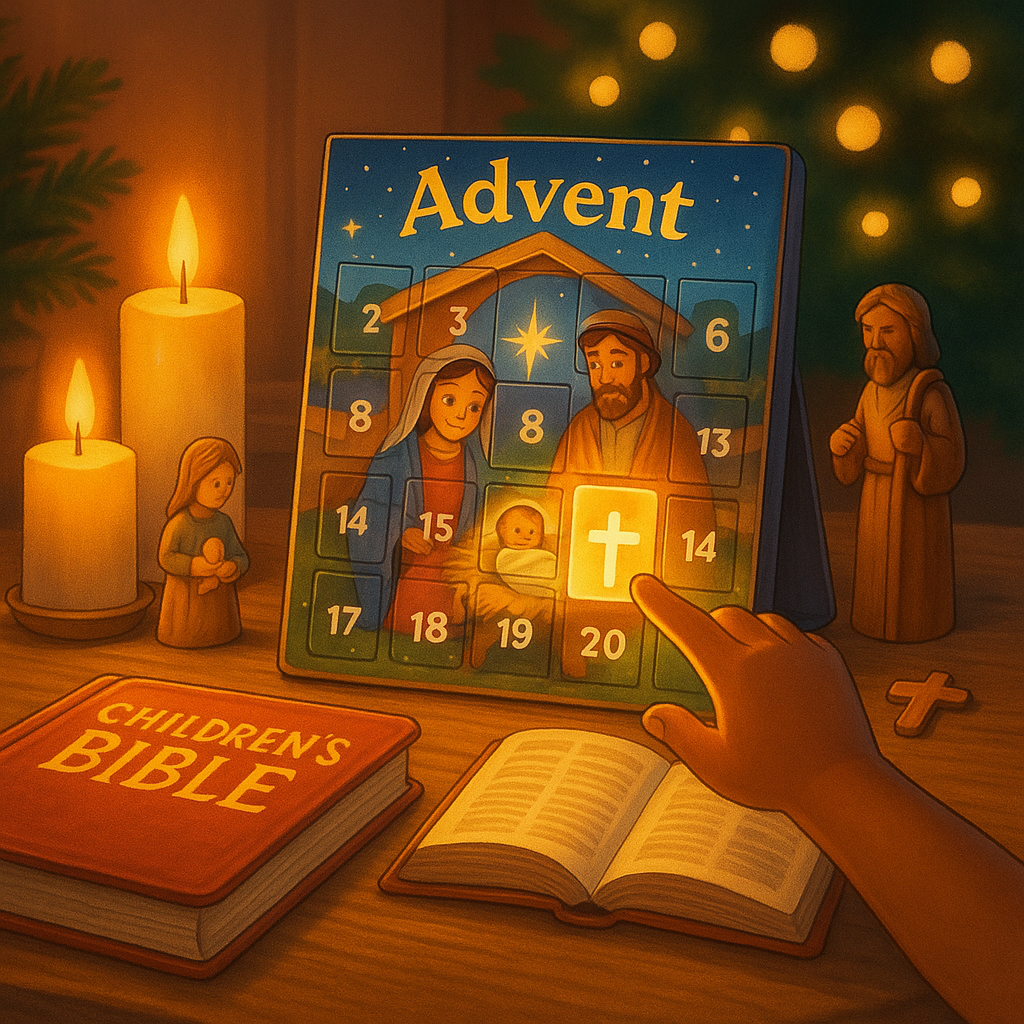
December arrives with its whirlwind of shopping lists, school programs, and cookie exchanges—and somewhere in the chaos, the reason for the season gets buried under wrapping paper. A Christian Advent calendar for kids offers families a simple daily rhythm that shifts focus from presents under the tree to the greatest gift ever given: Jesus himself.
This guide walks through what makes a faith-based Advent calendar different from chocolate countdowns, why 25 days of Bible stories prepare children's hearts for Christmas, and how busy families can maintain this tradition even when December feels overwhelming.
What Is a Christian Advent Calendar for Kids
A Christian Advent calendar for kids is a daily countdown tool that prepares children's hearts for Christmas by focusing on Bible stories rather than chocolate or toys. The word "Advent" means "coming" or "arrival," referring to the four weeks before Christmas when Christians prepare to celebrate Christ's birth. Unlike secular calendars that simply mark time until presents appear under the tree, a faith-based calendar tells the story of how God kept His promise to send a Savior.
Most Christian Advent calendars include three core components working together:
1. Bible verses: Daily scripture readings that trace God's rescue plan from Genesis to the manger
2. Devotions: Short reflections that help children connect ancient promises to their own lives
3. Activities: Crafts, songs, or service projects that make each day's lesson stick
The beauty of this approach lies in shifting focus from what's under the tree to the greatest gift ever given. While the secular world counts down to gift-giving, families using a Bible-based calendar count up to Jesus himself.
Why 25 Days Leads Children From Genesis to the Manger
Starting December 1st and ending Christmas Day gives families nearly four full weeks to journey through Scripture together. This isn't arbitrary timing—it mirrors the traditional Advent season while providing enough days to tell the complete story of God's plan for humanity. Beginning with Old Testament prophecies allows children to see that Jesus' birth wasn't a surprise but the fulfillment of promises God made thousands of years earlier.
The chronological approach helps children grasp the "big story" of the Bible rather than viewing Jesus' birth as an isolated event. When a child hears about God's promise to Abraham in Genesis 12, then later reads Luke 1 about Mary's lineage, suddenly the connection becomes clear. God keeps His word across generations, which builds faith by showing that the same God who fulfilled ancient promises still keeps His promises today.
1. Old Testament promises: Establish humanity's need for a Savior and God's plan to provide one
2. Prophecies fulfilled: Demonstrate God's faithfulness as predictions about the Messiah's birthplace, lineage, and mission come true in Jesus
3. Christmas story passages: Bring the long-awaited promise to life in the humble setting of a Bethlehem stable
What Comes in a 25 Day Bible Stories Calendar
Most Christian Advent calendars include printed materials, though digital options are increasingly popular for tech-savvy families. Physical calendars often feature a large poster with numbered doors or pockets, each containing that day's verse card featuring short Bible verses and an activity suggestion. Some include small nativity pieces that children add to a scene throughout the month, building anticipation as the manger fills.
Digital calendars and Bible apps offer interactive features like audio Bible readings, animated videos, and push notifications that remind busy families it's devotion time. The trade-off between physical and digital often comes down to family preference—some children respond better to tangible items they can touch and display, while others engage more deeply with multimedia presentations. Both formats typically include a parent guide with discussion questions and activity instructions.
Step-By-Step Guide to Using the Calendar as a Family
1. Choose a Set Time and Place
Consistency matters more than perfection when establishing this new tradition. Many families find success gathering around the breakfast table before school, creating a calm start to busy December days. Others prefer bedtime, using the devotion as a wind-down activity that replaces one bedtime story. Weekend mornings offer flexibility for families whose weekday schedules feel too rushed.
The location matters less than the routine—whether it's the living room couch, the kitchen table, or even the car during morning carpool. What children remember isn't the perfect setting but the regular rhythm of gathering together to hear God's word.
2. Read the Verse Aloud
Let children take turns reading or assign the task to whoever's turn it is that day. For pre-readers, audio versions or parent narration work beautifully—the goal is hearing God's word together, not perfect pronunciation. Some families enhance this step by lighting a special Advent candle, creating a sensory cue that signals "this time is different."
Reading aloud also slows everyone down in a season that tends toward frenzy. When a child stumbles over "Zechariah" or asks what "Ephrathah" means, those moments become opportunities for connection rather than interruptions.
3. Ask the Daily Discussion Question
Good discussion questions help children move from "what does it say" to "what does it mean for me." Instead of asking "What happened in this story?" try "How do you think Mary felt when the angel appeared?" or "When have you needed to be brave like Joseph?" Open-ended prompts invite children to connect ancient stories to their own experiences of fear, hope, and trust.
Younger children might answer with one word while pre-teens offer paragraphs—both responses are valuable. The goal isn't theological precision but personal engagement with Scripture.
4. Pray a One Sentence Prayer
Simple prayers work best for children who are still learning to talk to God. "Thank you, God, for sending Jesus" or "Help me trust you like Mary did" teach children that prayer is conversation, not performance. Let children pray in their own words rather than repeating after an adult—even the simplest, most awkward prayer is precious to God.
5. Do the Suggested Activity
Activities cement learning in ways that words alone cannot. When a child colors a picture of baby Jesus or makes a paper star like the one the wise men followed, the story becomes tangible. Service projects—like making cards for nursing home residents or collecting canned goods for a food bank—are great for teaching children how to give gifts and help them understand that Jesus came to serve others.
Not every activity requires completion—if your family skips the craft one day because of a soccer game, that's perfectly fine. The relationship matters more than checking boxes.
25 Daily Bible Readings and Simple Devotions
1. Genesis 3 Promise of a Savior
After Adam and Eve disobey God, He promises that one day someone will "crush the serpent's head"—the first hint that God has a rescue plan. Even when humanity fails, God doesn't give up on us.
2. Genesis 12 Blessing to All Nations
God tells Abraham that through his family "all peoples on earth will be blessed." This promise points forward to Jesus, who would come from Abraham's family line to bless every nation.
3. Exodus 12 Passover Lamb
God protects His people by having them mark their doors with lamb's blood, foreshadowing "the Lamb of God who takes away the sin of the world." Jesus becomes the ultimate Passover lamb who saves us.
4. Ruth 4 Kinsman Redeemer
Boaz rescues Ruth's family by becoming their "kinsman redeemer," just as Jesus redeems us from sin and death. This beautiful love story points to God's greater love story.
5. Isaiah 9 Prince of Peace
Isaiah prophesies that a child will be born who is "Wonderful Counselor, Mighty God, Everlasting Father, Prince of Peace." The names describe Jesus perfectly.
6. Micah 5 Bethlehem Foretold
The prophet Micah declares that "Bethlehem" will be the birthplace of Israel's ruler, even though it's a tiny town. God often works through small, unexpected places.
7. Luke 1 Gabriel Visits Zechariah
Angel Gabriel announces that Zechariah and Elizabeth will have a son named John who will "make ready a people prepared for the Lord." God keeps His promises even when we doubt.
8. Luke 1 Mary's Yes to God
When the angel tells Mary she'll give birth to God's son, she responds "may your word to me be fulfilled." Her trust teaches us to say yes to God's plans.
9. Luke 1 Mary Visits Elizabeth
Elizabeth's baby leaps for joy when Mary arrives, and Elizabeth exclaims "blessed are you among women." Even unborn John recognizes Jesus' presence.
10. Luke 1 Zechariah Praises God
After months of silence, Zechariah prophesies that his son will prepare people for "the rising sun from heaven." God's light is coming to shine in the darkness.
11. Matthew 1 Joseph's Dream
An angel tells Joseph to marry Mary because her baby is "conceived by the Holy Spirit." Joseph's obedience shows that following God sometimes means trusting what we don't understand.
12. Luke 2 Journey to Bethlehem
Mary and Joseph travel to Bethlehem for the census, fulfilling Micah's prophecy about where the Messiah would be born. God uses even government rules to accomplish His purposes.
13. Luke 2 No Room in the Inn
The inn has no space, so Jesus is born in a stable—God's son enters the world in the humblest circumstances. This shows that Jesus came for everyone, not just the wealthy or powerful.
14. Luke 2 Jesus Is Born
The long-awaited Savior arrives as "a baby wrapped in cloths and lying in a manger." The King of Kings comes as a helpless infant who needs care, showing God's incredible love.
15. Luke 2 Angels Announce Good News
Angels proclaim to shepherds "good news that will cause great joy for all people—today a Savior has been born." The best news in history is announced to ordinary working people first.
16. Luke 2 Shepherds Worship
Simple shepherds become the first to worship Jesus, showing that God values humble hearts over social status. Anyone can come to Jesus, no matter their job or background.
17. Luke 2 Mary Treasures These Things
Mary "treasured up all these things and pondered them in her heart," teaching us to remember and reflect on what God does. Taking time to think about God's goodness helps our faith grow.
18. Matthew 2 Wise Men See the Star
Foreign scholars follow "his star in the east" to worship the newborn King. Jesus came for all nations, not just the Jewish people.
19. Matthew 2 Gifts of Gold Frankincense Myrrh
The wise men's gifts represent Jesus as King (gold), Priest (frankincense), and Sacrifice (myrrh) for humanity. Even early gifts point to who Jesus would become.
20. Matthew 2 Escape to Egypt
God protects baby Jesus from King Herod's evil plan, showing divine care for His Son. God watches over us too, even when we face danger.
21. Isaiah 53 Suffering Servant
Isaiah foretells that the Messiah will be "pierced for our transgressions" to bring us peace. Jesus' birth leads to His death and resurrection—the complete story of salvation.
22. John 1 Word Became Flesh
John explains that "the Word became flesh and made his dwelling among us"—God became human. This mystery is at the heart of Christmas.
23. Galatians 4 Fullness of Time
Paul teaches that Jesus came "when the set time had fully come" according to God's perfect plan. God's timing is always right, even when we're impatient.
24. 1 John 4 God's Perfect Love
John declares that "God is love" and showed His love by sending Jesus as our Savior. Christmas is ultimately about God's love for us.
25. Revelation 21 Jesus Makes All Things New
The Bible ends with Jesus promising "I am making everything new"—our eternal hope. The baby in the manger grows up to defeat death and give us forever life with Him.
Faith Filled Activities That Reinforce Each Day's Story
Nativity Craft Ideas
Simple fun Christmas activities using household items make the Christmas story tangible for young hands. Paper plate mangers require only a plate, construction paper, cotton balls for sheep, and markers. Toilet paper roll shepherds and angels transform trash into treasures while teaching the story. Older children enjoy more complex projects like constructing a cardboard stable or sewing felt nativity figures.
Service Projects for Kids
Connecting Bible stories to real-world action helps children understand that Jesus came to serve others. Younger children can draw cards for hospital patients or nursing home residents. Elementary-aged kids can sort donations at a food bank or collect winter coats for those in need. Pre-teens might organize a toy drive, shovel an elderly neighbor's driveway, or use allowance money to sponsor a child through a Christian organization.
Worship Song Playlists
Music embeds truth in children's hearts in ways that reading alone cannot. Traditional carols like "O Come, O Come Emmanuel" and "Hark! The Herald Angels Sing" connect children to centuries of believers who've sung the same truths. Contemporary Christian songs by artists like Phil Wickham or Chris Tomlin offer fresh expressions of ancient promises.
From Scripture to Gameplay: TruPlay Connections
Digital engagement doesn't have to compete with Bible learning—it can enhance it. TruPlay's RhymVerse adventures feature biblical storytelling woven into gameplay that children actually want to play. After reading about brave Mary or faithful Abraham, children can explore similar themes of courage and trust through interactive stories where characters face challenges by relying on God.
Celebrate Christmas Morning With Lasting Family Joy
The real gift of a 25-day Advent journey isn't perfect attendance or completed crafts—it's hearts prepared to celebrate Jesus. When Christmas morning arrives and presents are opened, children who've spent December hearing God's story understand that the best gift isn't under the tree. They've learned that the baby in the manger grew up to defeat death and give eternal life to everyone who believes in Him.
This perspective doesn't diminish the joy of Christmas morning but enhances it. Presents become expressions of love that point to God's ultimate gift rather than the main event. Family traditions gain deeper meaning when rooted in the story of God's faithfulness across generations.
Get started with your free 7-day trial today and turn game time into God time for your family. Download the TruPlay app from the Apple App Store or Google Play to unlock a safe, fun, and faith-filled entertainment experience for your kids.
FAQs About Christian Advent Calendars
How long does each daily Christian advent devotion take?
Most family devotions take 10-15 minutes including Bible reading, discussion, and prayer. Busy families can complete the essentials in just 5 minutes by reading the verse, asking one quick question, and praying together.
Can families start a 25 day advent calendar after December 1st?
Yes, families can begin anytime in December and either catch up quickly or extend the calendar past Christmas Day. The goal is family connection with God's story, not perfect timing.
What parents do if their child misses a day of advent devotions?
Simply continue with the current day rather than trying to catch up, which creates stress instead of joy. Consistency matters more than perfection, and skipping a day doesn't ruin the entire experience.
Are there Christian advent calendars designed for children with special needs?
Many advent resources include visual aids, simplified language, and sensory activities that work well for children with different learning styles and abilities. Families can also adapt any calendar by focusing on pictures, using fewer words, or emphasizing hands-on activities over reading.
Do families need to buy extra supplies for advent calendar craft activities?
Most suggested activities use common household items like paper, crayons, glue, and basic craft supplies. Families can adapt or skip activities based on available materials.