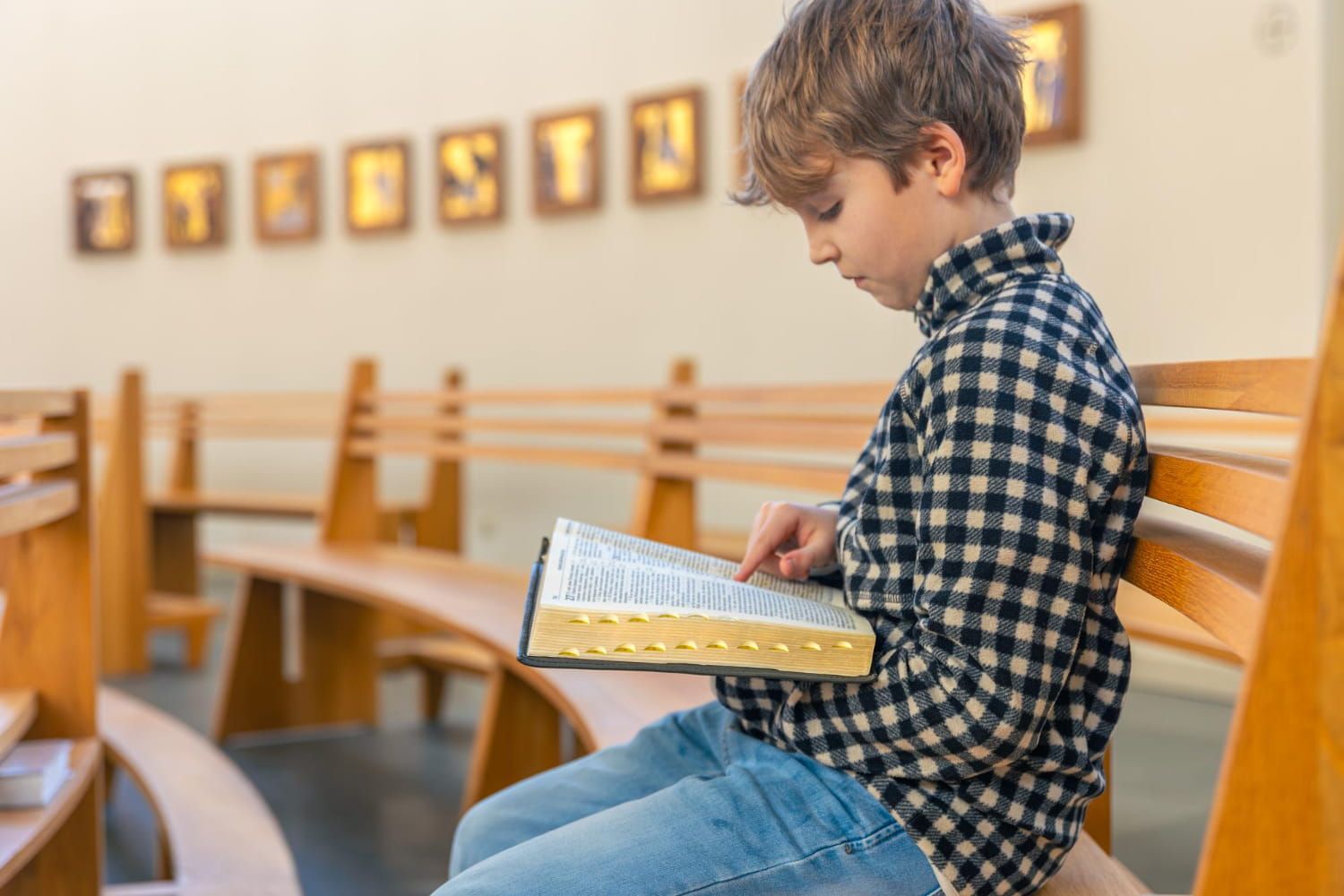
How to Make Daily Devotions Work for Kids Who Won't Sit Still
6/23/2026

You bought the devotional book. The one with the bright cover and the five-star reviews. Night one went fine. Night two, your kid started fidgeting. By night four, the book sat untouched on the nightstand, and you felt like a failure.
Sound familiar? Most Christian parents have lived this cycle with devotions for kids more than once. Start strong, lose steam, feel guilty, try again with a different book, repeat.
But the problem isn't your kid. It isn't even the book. What most families hit is a format mismatch: the devotional asks a child to sit, read, and reflect, but the child's brain and body are wired for something else. A wiggling six-year-old doesn't need more discipline at devotional time. She needs a different kind of devotional.
This guide walks through why children resist traditional devotional formats, what alternatives look like at different ages, and how to build a daily habit your family will keep past the first week.
Why Kids Push Back on Devotional Time

When a child fights you on devotional time, they aren't rejecting God. A seven-year-old hasn't evaluated theology and decided Scripture isn't for him. What he's rejecting is a format that asks him to do the thing he's worst at: sit still, process text, and reflect quietly.
That's a developmental reality, not a spiritual deficit.
Children between ages four and eight learn through their senses, through movement, through stories that pull them in. Sitting with a printed page and thinking about what a verse "means to them" is a graduate-level exercise for a brain that's still learning to tie shoes. No wonder their eyes glaze over.
Older kids, nine through twelve, resist for a different reason. If devotional time carries the same energy as homework, it lands in the same mental box: obligations someone else imposed. And obligations breed resentment, not love for God's Word.
So the better question for parents isn't "how do I get my child to do devotions?" It's "what form of devotional time fits my child right now?"
What Counts as a Devotion?
A devotion is any intentional time spent connecting with God through His Word. It can look like a bedtime reading, a conversation in the car, a prayer walk through the neighborhood, a Bible-based game on a tablet, or five minutes with a Scripture word puzzle. Whether your child connects with God matters more than which format gets them there.
That word "devotional" intimidates a lot of parents. It conjures an image of a small hardcover book with dated entries and discussion questions, the kind stacked three rows deep at the Christian bookstore. Those books can be wonderful. But they represent one format among many, and for the kid who won't sit still, they're often the wrong starting point.
The definition is simpler than the word suggests. Scripture plus conversation plus regularity. That's a children's daily devotional, whether it happens at a kitchen table with a book or on a screen with a game that reveals a new Bible verse at every level.
Finding the Right Format for Your Child's Age
Not every devotional approach works at every age. A format that captivates a four-year-old will bore a ten-year-old, and vice versa. The table below gives a starting framework, but your child is the real guide here. Watch what holds their attention and follow that signal.

Ages 3-5: Story and Sensory
At this age, the story IS the devotion. Read a picture Bible aloud. Sing "Jesus Loves Me" together. Hand your child crayons and a coloring page of Daniel in the lions' den. These moments build a foundation that formal Bible study will deepen later.
Don't underestimate what sticks. A three-year-old coloring a picture of Noah's ark while you narrate the story is absorbing more than you think. The images, the sound of your voice, the physical act of filling in color: it all encodes together.
Digital options work here too. TruPlay's Book of Imagination is built for this exact window. Kids color hand-drawn scenes from the RhymVerse (TruPlay's original story world), and when they finish, the picture animates and turns into a short moving scene. It's coloring with a payoff, and every image tells part of a larger story about characters who face real fears and learn to trust God through them.
"Start children off on the way they should go, and even when they are old they will not turn from it." - Proverbs 22:6 NIV
Ages 6-8: Action and Participation
Six, seven, eight. Interactive devotions for kids gain traction at this age. Children want to DO something: press buttons, solve puzzles, act things out, feel like they're part of the story rather than spectators.
Formats that click at this stage: acting out Bible stories in the backyard. Prayer walks where you thank God for everything you see. Family dinner questions like "where did you notice God today?" Digital Bible games where Scripture is woven into the gameplay, not tacked on as a loading screen.
Lumi's Words of Light on TruPlay fits this age bracket well. Each level shows a Bible verse with a key word missing (LOVE, PEACE, POWER, GRACE, REFUGE, and dozens more). Your child solves for the missing word, and when they get it right, the full verse appears alongside a personal application framed as God's love letter to the player. Thirty-plus Scripture passages, each one taking only a few minutes. A kids devotional disguised as a puzzle game.
Ages 9-12: Ownership and Choice
At nine, ten, eleven, twelve, children need to feel like their devotional time belongs to them, not to you. The moment it becomes something you impose, it becomes something they endure.
Give options. A devotional journal they pick out themselves. An audio devotional they listen to on the ride to practice. A contemplative puzzle game they can play before bed. Let them choose, and the resistance drops.
For kids in this age range who love games, TruPlay's Stained Glass was made for them. It's a Match-3 puzzle (same genre as Candy Crush, but built around Scripture) where completing levels earns stained glass pieces that assemble into cathedral windows. Finish a window, and it unlocks an animated scene from Scripture: the stories of Eve, Moses, and Noah told across 144 levels and 36 animated sequences. Twenty-plus hours of quiet, meditative Bible engagement. The kind of daily devotional for kids who'd never crack a devotional book but will happily play "just one more level" before lights-out.
Five Devotional Formats That Work When Books Don't

If your child has bounced off every devotional book you've tried, stop buying books. These five formats reach kids through different channels.
1. Game-based devotions
Bible games where Scripture lives inside the story, not stapled to the margins. The difference matters. Kids remember what they experience firsthand. A child who spends twenty minutes guiding a character through a world where Bible verses shape the journey absorbs those verses differently than a child who reads them off a page. TruPlay carries 35+ titles built around this approach, spanning puzzles, runners, action RPGs, and more. No ads, no chatrooms, no in-app purchases.
2. Conversation devotions
No book required. One question at the dinner table: "What's something you're grateful for today?" or "Is anything worrying you that we could pray about together?" Let the Bible enter through the discussion. Works at every age. Costs nothing.
3. Audio devotions
Podcasts, Scripture read aloud through an app, or a family audiobook of Bible stories. Perfect for car rides, for auditory learners, and for mornings when nobody has the energy to sit at a table. Keys for Kids and the YouVersion Bible App both offer free options worth trying.
4. Movement devotions
Prayer walks around the block. Acting out David and Goliath in the backyard. "Simon Says" with Fruit of the Spirit prompts ("Simon says show me patience... Simon says show me kindness"). For kinesthetic kids, if the body isn't involved, the brain checks out.
5. Art and creative devotions
Drawing a scene from a Bible passage. Journaling a prayer. Coloring pages tied to Scripture stories. Good as a wind-down before bed, and kids walk away with a physical artifact they made, something they'll remember because their hands built it.

Building the Habit Without the Fight
- Same time, same cue. Attach devotional time to something that already happens every day: right after breakfast, during the drive to school, the ten minutes before bed. The existing routine carries the new habit. You don't need to carve out a special window. Piggyback on one you already have.
- Start shorter than you think. Three minutes of engaged time beats fifteen minutes of glazed-eye compliance. You'll want to overplan the first week. Resist that. Begin with a length your child can handle without losing focus, then add from there.
- Let them pick. Hand your child two or three format options and let them choose. "Do you want to read a story, play the Bible word game, or do a prayer walk tonight?" Ownership kills resistance faster than any motivational speech about why the Bible matters.
- Drop the quiz. The moment devotional time includes comprehension questions or a performance check, it becomes school. Ask "what stuck with you?" instead of "what did you learn?" Even better, share what stuck with YOU. If you want your child to be open about their faith, let them see you being open about yours.
- Celebrate showing up, not performance. A kid who plays a Bible puzzle game for five minutes and walks away humming the verse from the level just had a devotion. It doesn't need to look like yours looked when you were growing up. Consistency counts. Perfection doesn't.
Screen Time or Scripture Time? It Doesn't Have to Be One or the Other

This is the tension nobody talks about at the parenting small group. You know screen time is a battleground. You've read the articles. You've set the timers. And you also know your kid, the one who squirms through every bedtime reading, will happily spend thirty minutes on a tablet without blinking.
That tension tempts parents toward an all-or-nothing position: screens are bad and we do everything analog, or we give up and hand over the iPad. Neither works.
The better filter isn't "screens or no screens." It's "what's on the screen?"
A child solving a word puzzle for Jeremiah 29:11, "For I know the plans I have for you... plans to give you hope and a future," is doing something qualitatively different from scrolling YouTube. A kid reassembling the story of Moses told through animated stained glass windows is building Bible literacy in a form their brain can absorb. Not all screen time is the same. What's on the screen matters more than whether the screen is on.
When evaluating digital options, look for three things:
- First: is Scripture woven into the experience, or just painted on top?
- Second: is the environment safe (no ads, no chat functions, no in-app purchases, third-party safety certification)?
- Third: does the content respect your child's intelligence, or is it dumbed-down busywork dressed in Bible clip art?
TruPlay passes all three. One subscription covers up to 10 family profiles, a 7-day free trial lets you test before spending a dollar, and every title carries the kidSAFE Seal.
Verses to Anchor Your Family's Devotional Life
These four passages connect to why daily time in Scripture matters and how it shapes a family. They're as much for you, the parent, as they are for your children.
"Your word is a lamp for my feet, a light on my path." - Psalm 119:105 NIV
The metaphor clicks for kids: God's Word shows us where to step next, even when we can't see far ahead.
"These commandments that I give you today are to be on your hearts. Impress them on your children. Talk about them when you sit at home and when you walk along the road, when you lie down and when you get up." - Deuteronomy 6:6-7 NIV
Notice what this verse assumes about format. Sitting, walking, lying down, getting up. Devotional time isn't confined to a chair and a book. God always intended it to move with the family throughout the day.
"Do not merely listen to the word, and so deceive yourselves. Do what it says." - James 1:22 NIV
For kids who are doers and builders, this verse validates the impulse. Faith was never meant to be passive. It's meant to be acted on, put into practice, tested against the real world.
"But his delight is in the law of the Lord, and on his law he meditates day and night. That person is like a tree planted by streams of water, which yields its fruit in season and whose leaf does not wither." - Psalm 1:2-3 NIV
The image of a tree with deep roots is one that children grasp immediately. Small, steady time in the Bible grows something that doesn't break when life gets hard.
Looking for more verses to use with your kids? Our collection of 60 inspirational Bible verses for kids covers courage, love, identity, and more.
FAQ
At what age should kids start doing devotions?
There's no minimum age. A two-year-old hearing a Bible story read aloud is having a devotion. A four-year-old singing about Jesus is having a devotion. Start as early as your family wants, and adjust the format to match what your child can absorb. Formal, independent devotional time tends to become realistic around ages seven or eight, but parent-led devotions for kids belong at every stage of childhood.
How long should a devotional for kids last?
As long as your child stays engaged, and not a minute longer. For preschoolers, that might mean three minutes. For a ten-year-old, ten to fifteen. Pushing a child past their attention threshold doesn't build discipline. It builds resentment. Start short. Let the habit take root before you extend the time.
What if my child has no interest in reading the Bible?
Then don't start with reading. Start with a game, a song, a conversation, a walk. The Bible can enter through a dozen doors besides the front cover of a book. A child who plays a game where Scripture shapes the story is engaging with God's Word even if they never "sat down to read." Match the format to the child, not the other way around.
Can games on a screen count as devotional time?
Yes, if the game puts Scripture at the center of the experience rather than using it as decoration. A Bible-based game where each level teaches a verse, tells a biblical story, or walks a child through themes like courage, identity, and trust in God does devotional work. The format differs from a book. The spiritual formation does not. Look for platforms that run ad-free, carry a safety certification like the kidSAFE Seal, and ground their content in real Scripture rather than vague spiritual sentiment.
What's the best daily devotional for kids who get bored with books?
The one that matches how your child learns. Kinesthetic kids need movement: prayer walks, acting out stories. Auditory kids need sound: podcasts, read-aloud Scripture. Visual and interactive kids need something to do with their hands and eyes: games, art, puzzles. There is no single "best" for every child. The best devotional is the one your kid will come back to tomorrow.