AI And Your Child's Faith: A Christian Parent's Guide For 2025
10/27/2025
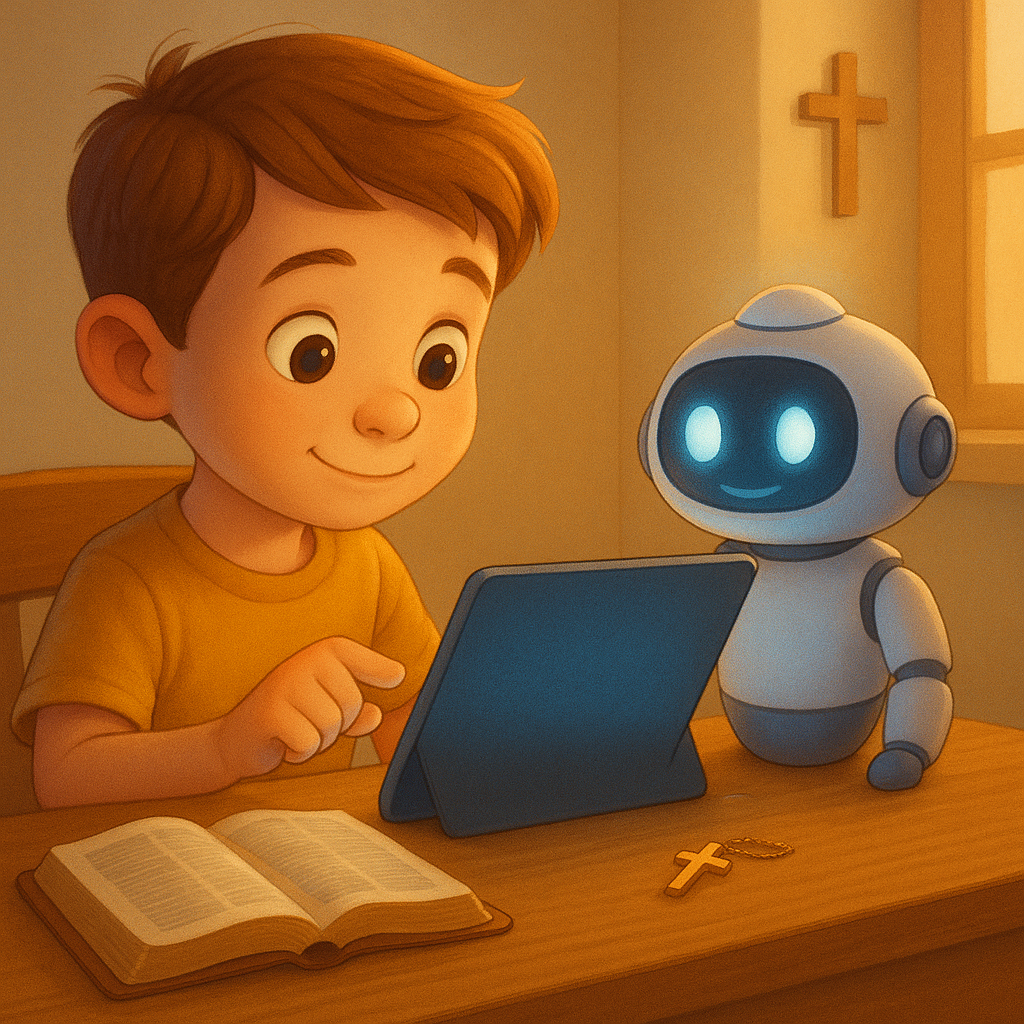
Your seven-year-old asks Alexa about God, and the answer she receives sounds nothing like what you've taught her at church. Meanwhile, your middle schooler uses ChatGPT to write his Sunday school reflection, and you're not sure whether to be impressed by the efficiency or concerned about what he's actually learning.
Artificial intelligence has quietly become a constant presence in your children's lives—shaping their homework, entertainment, and increasingly, their understanding of faith and truth. This guide walks you through the real risks and surprising benefits of AI for your child's spiritual development, along with practical steps to help your family navigate this new landscape with biblical wisdom.
What Christian Parents Need To Know About AI Right Now
Artificial intelligence—or AI—refers to computer systems that learn patterns, generate responses, and mimic human thinking. In 2025, AI has quietly become as common in children's lives as smartphones were a decade ago. Your child likely interacts with AI multiple times a day without you realizing it.
The real challenge isn't whether AI exists in your home—it almost certainly does. The question is whether you're aware of it and whether you're helping your child engage with it wisely. AI can offer genuine benefits for learning and faith formation, but it also carries risks that Christian parents can't afford to ignore.
How AI Is Already Shaping Your Child's World
Most parents underestimate how deeply AI has woven itself into their children's daily routines. From homework help to entertainment, AI is quietly learning your child's preferences and shaping their experiences in ways that aren't always visible.
Learning Apps And Homework Helpers
ChatGPT can write essays, solve math problems, and answer questions on virtually any topic—often faster than you can look up the answer yourself. Educational platforms like Khan Academy, Duolingo, and Quizlet use AI to adapt lessons to each student's pace, creating personalized experiences that feel almost magical.
About four out of ten parents report their children under two years old use or interact with smartphones, while approximately four out of ten parents say their children aged twelve or younger use voice assistants. Over half of Gen Alpha children ages zero to two already possess tablets, with ownership peaking at forty-nine percent overall.
ChatGPT can write essays, solve math problems, and answer questions on virtually any topic—often faster than you can look up the answer yourself. Educational platforms like Khan Academy, Duolingo, and Quizlet use AI to adapt lessons to each student's pace, creating personalized experiences that feel almost magical. Twenty-six percent of US teens now use ChatGPT for schoolwork, doubling from thirteen percent in 2023. Black and Hispanic teens showed the highest usage rates at thirty-one percent each, compared to twenty-two percent among White teens.
The concern isn't the technology itself but the habit it forms. Why struggle through a difficult problem when AI solves it instantly? That shortcut mentality can undermine the character-building work of perseverance that Scripture values so highly.
Smart Toys And Voice Assistants
If your tween or teen uses social media, AI curates their entire experience. Algorithms decide which posts appear in their feed, which videos autoplay next, and which ads target their interests. The danger here is subtle but profound: AI creates echo chambers that reinforce whatever worldview a child already holds, or worse, gradually shifts their values toward whatever content keeps them scrolling longest. And the risks extend beyond content: Amazon was charged with violating COPPA by keeping children's voice recordings indefinitely unless parents requested deletion, and even when deletion was requested, Amazon failed to remove transcripts from all databases; the company retained children's voice recordings to improve Alexa's ability to understand children's speech patterns, providing valuable training data while putting privacy at risk.
Social Media Algorithms And Filters
If your tween or teen uses social media, AI curates their entire experience. Algorithms decide which posts appear in their feed, which videos autoplay next, and which ads target their interests. The danger here is subtle but profound: AI creates echo chambers that reinforce whatever worldview a child already holds, or worse, gradually shifts their values toward whatever content keeps them scrolling longest.
Blessings AI Can Bring To Your Child's Faith Journey
Despite legitimate concerns, AI can genuinely serve families when used with wisdom and clear boundaries. Romans 8:28 reminds us that God works all things together for good for those who love Him—and that includes technology when stewarded well.
AI-powered Bible apps can adapt Scripture memory programs to your child's age, learning style, and progress. A struggling reader might receive audio support while an advanced student gets deeper theological questions. For children with learning disabilities, visual impairments, or other challenges, AI can be genuinely transformative. Text-to-speech technology reads Scripture aloud with natural inflection, and adaptive learning features adjust pacing based on a child's needs.
AI can also generate creative prompts for family devotions, suggest age-appropriate worship songs, or help children write prayers based on biblical themes. The caution here is discernment—not every AI-generated devotional reflects sound theology, so parents will want to preview content before sharing it with children.
Spiritual And Ethical Risks To Watch For
Proverbs 4:23 warns us to guard our hearts, for everything we do flows from them. When it comes to AI, this means staying alert to subtle dangers that can shape children's understanding of truth, identity, and morality.
AI systems learn from massive datasets scraped from the internet, which means they absorb and reflect the dominant cultural values of our time. When children ask AI theological questions, the answers often reflect secular humanism rather than biblical truth. Common biases include:
- Moral relativism: AI frequently presents all belief systems as equally valid, avoiding absolute truth claims
- Secular humanism: Responses emphasize human potential over dependence on God
- Anti-biblical values: Questions about gender, sexuality, or life ethics may receive answers that contradict Scripture
Beyond worldview concerns, there's the issue of data privacy. Every interaction with AI creates a digital footprint. Companies collect information about your child's interests, questions, struggles, and habits—data that can be sold, analyzed, or used to influence future behavior.
There's no one-size-fits-all answer to this question, which is why biblical wisdom emphasizes parental discernment over rigid rules. Proverbs 22:6 encourages us to train up a child in the way he should go—recognizing that each child's developmental readiness differs. Students who frequently rely on AI tools demonstrated lower critical-thinking scores compared to their peers, with younger participants aged seventeen to twenty-five showing higher AI dependence and lower thinking scores. Excessive reliance on AI for complex reasoning tasks could significantly weaken students' ability to think analytically and solve problems independently.
Then there's the dependency problem. AI makes screens more engaging than ever, which can lead to genuine addiction patterns in young brains. More than seventy percent of teens have used AI companions, with thirty-one percent saying their conversations with AI companions were 'as satisfying or more satisfying' than talking with real friends. Thirty-three percent had discussed serious or important issues with AI instead of real people. The convenience of instant answers creates dependency—why think deeply or seek wisdom from mentors when AI provides immediate responses? Hebrews 10:24-25 calls us to consider how to stir up one another to love and good works, not forsaking the assembling of ourselves together. AI can't replace the spiritual formation that happens in relationships with parents, pastors, and Christian mentors.
What Age Is Appropriate For Kids To Use AI Tools?
There's no one-size-fits-all answer to this question, which is why biblical wisdom emphasizes parental discernment over rigid rules. Proverbs 22:6 encourages us to train up a child in the way he should go—recognizing that each child's developmental readiness differs.
Young children are still forming foundational concepts about reality, relationships, and truth. For preschool and early readers, human interaction far outweighs any benefit AI might offer. A preschooler who learns to ask Alexa questions instead of asking Mom or Dad is missing crucial relational development.
As children enter the middle years, they often become curious about technology and eager to explore creative tools. This can be an appropriate time to introduce AI under clear supervision—perhaps using it for school projects, creative writing prompts, or exploring interests like coding. The key is teaching critical thinking alongside access. When your tween uses AI to research a topic, ask them to compare the response with other sources and discuss what they found.
By high school, most students will need some familiarity with AI simply to function in modern academic and professional settings. The question shifts from "if" to "how"—helping teens use AI responsibly while maintaining biblical values.
Setting Christ-Centered Boundaries And Parental Controls
Establishing boundaries isn't about fear or control—it's about biblical stewardship and discipleship. Ephesians 6:4 calls parents to bring children up in the discipline and instruction of the Lord, which includes how we engage with technology.
Rather than imposing rules from the top down, consider creating a written family agreement that reflects your Christian values. This covenant might include commitments like praying before using AI tools, bringing theological questions to parents first, or taking regular breaks for family connection and worship. Involving age-appropriate children in creating guidelines helps them internalize values rather than simply obeying external rules.
Several Christian-friendly options can help parents monitor AI use without resorting to surveillance that damages trust. Tools like Bark, Covenant Eyes, and Circle offer varying levels of content filtering, screen time management, and activity monitoring. The distinction between transparency and surveillance matters. Explain to your children why you're using monitoring tools—not because you don't trust them, but because you're helping them develop self-control in an environment designed to be addictive.
The biblical concept of Sabbath—setting aside time to rest and focus on God—applies beautifully to technology. Consider establishing regular digital detox periods: perhaps Sunday afternoons, family meal times, or the hour before bed. These breaks create space for the kind of unhurried conversation, creative play, and spiritual reflection that rarely happens when devices are present.
Talking To Kids About AI And God
First Timothy 4:12 encourages young believers to set an example in speech, conduct, love, faith, and purity—but they can only do this if we equip them with biblical wisdom about the world they're navigating. Conversations about AI and faith don't have to be complicated; they just need to be consistent.
For younger children, frame discussions around clear contrasts between God's wisdom and human-made tools. Ask simple questions: Who made everything we see? Who made computers and robots? If a device says something unkind or untrue, what do we do? Can Alexa love you the way Jesus does? These questions help children understand that AI is a tool created by people, not a source of truth or relationship.
As children's thinking becomes more abstract, they can explore deeper questions about what makes humans unique. Try conversations like: What's the difference between information and wisdom? Can a computer be creative, or is it just combining things people already made? If AI can do many things humans can do, what makes us special to God?
Teenagers are ready for philosophical conversations about consciousness, morality, and purpose. Don't shy away from hard questions: Can AI ever become conscious or have a soul? If AI makes moral decisions, who's responsible—the programmer, the user, or the machine? How does relying on AI for answers affect our relationship with God, who promises wisdom to those who ask?
Trusted Faith-Based Apps, Games, And Resources
Finding entertainment and educational content that aligns with Christian values can feel like searching for treasure in a cultural minefield. The good news? That treasure exists, and it's more accessible than ever.
TruPlay Games creates digital entertainment specifically designed to nurture children's faith while keeping them engaged. Unlike mainstream gaming platforms where parents worry about hidden agendas or inappropriate content, TruPlay offers games, videos, and stories rooted in biblical truth. In the RhymVerse, villains represent real evil, heroes rely on God, and storylines teach biblical values without preaching. Parents can trust that game time is actually building faith rather than undermining it.
The Bible App for Kids, developed by YouVersion, brings Scripture to life through colorful animations, touch-activated activities, and age-appropriate devotionals. The app uses AI to suggest content based on a child's progress, making Bible engagement feel like an adventure rather than a chore. The app is free, ad-free, and available in dozens of languages.
Superbook offers classic animated Bible stories updated with modern animation and interactive features. The app includes full episodes, Bible games, and quizzes that help children remember what they've learned. While it doesn't use cutting-edge AI, it offers a safe alternative to YouTube's unpredictable algorithm.
Raising Light-Bearers In A Digital Age
Jesus called His followers the light of the world, a city set on a hill that cannot be hidden (Matthew 5:14-16). In 2025, that calling extends into digital spaces where darkness often masquerades as progress, convenience, or entertainment.
The challenge before Christian parents isn't to retreat from technology or to embrace it uncritically. It's to raise children who can engage AI and digital tools with discernment, wisdom, and unwavering commitment to biblical truth. This requires intentionality, ongoing conversation, and the humility to admit when we don't have all the answers.
Your children are growing up in a world you didn't experience as a child, but they're not navigating it alone. God's Word remains relevant, the Holy Spirit still guides, and Christian community still matters. When you combine timeless biblical principles with practical wisdom about modern technology, you equip your children to be light-bearers in whatever digital landscape they encounter.
Get started with your free 7-day trial today and turn game time into God time for your family. Download the TruPlay app from the Apple App Store or Google Play to unlock safe, fun, and faith-filled entertainment for your kids.
FAQs About AI And Christian Parenting
How can I tell if an AI app promotes non-biblical worldviews?
Look for content that contradicts Scripture regarding morality, gender, creation, or the nature of truth. Test the app by asking theological questions and comparing responses to what the Bible teaches. If an app consistently presents moral relativism or frames biblical values as merely one option among many, that's a red flag worth investigating further.
Should Christian families completely avoid AI chatbots like ChatGPT?
Some families may find it better to avoid AI chatbots altogether because of the risk of worldview exposure and the common thread of anti-biblical perspectives found in many AI-generated responses. If you feel you must introduce your child to AI tools, supervised use with clear guidelines is essential. Discuss appropriate questions, review responses together, and teach your child to verify any information against Scripture and trusted Christian sources before accepting it as truth.
Can AI tools help children with learning disabilities study the Bible?
Yes, AI-powered text-to-speech, visual aids, and adaptive learning features can make Scripture more accessible for children with dyslexia, ADHD, visual impairments, and other challenges. Many families find that AI assistance helps children engage with the Bible in ways that weren't possible before, removing barriers without compromising the integrity of God's Word.
What should I do if my child asks AI theological questions?
Use it as a teaching opportunity to compare AI responses with Scripture and discuss why the Bible is our ultimate authority. Encourage your child to bring spiritual questions to you, pastors, or trusted Christian mentors first, framing AI as a supplementary tool rather than a primary source of spiritual guidance. This builds the habit of seeking wisdom from godly people, not just convenient technology.